Friday, March 30, 2012

No Kettlebell Classes Saturday, March 31st

Just a reminder that classes are canceled tomorrow morning.  My wife and I will be competing in the Equinox Open powerlifting competition.  Yvette will be lifting around 9am, and I should be lifting around 10:30-11am. Our portion of the event should be completed between 9am-12noon.  For anyone wishing to come watch us perform, here is the address location:


CrossFit Diesel
9520 Gerwig Lane, Suite T,
Columbia, MD 21046
(We are located in the back of the building, behind "eventEQ")

Thanks,

Jason

Friday, March 23, 2012

WOD- Max Effort 1 Repeat

WOD:

3 Rounds of Max Weight (Ramp up the load each set)

Turkish Getup: 1 rep max
Bottom-up Clean and Press: 5 rep max (each side)
Suitcase Deadlift: 10 rep max (each side)

Compare with: 12/30/11

Friday, March 16, 2012

WOD- Cardio 6 REPEAT

AMRAP (as many reps as possible for each exercise in the given time frame prescribed.)

Turkish Getups- 5 minutes (prescribed weight: 35# male/ 8k female)

Clean and Press - 5 minutes (prescribed weight: 35# male/ 8k female)

Snatches -  5 minutes (prescribed weight: 35# male/ 8k female)

Compare to 12/22/11

Friday, March 9, 2012

WOD- Max Effort 5 REPEAT

You will have approximately 30 minutes to complete the 4 exercises below.  Your goal is to achieve the request repetition maximum (RM) for each exercise, on each arm, before moving onto the next exercise.  It should take you less than 5 sets to achieve the highest weight possible for each RM task.  Record the heaviest weight you used for the requisite RM prescription.

Bottom Up Turkish Getup - 1 RM

Bottom Up Clean and Press- 3 RM

Push Press - 3 RM

2 Hand Swing - 20 RM

Compare to: 1/13/12

Friday, March 2, 2012

WOD- Cardio 5 REPEAT

Descending Ladder ( Record time to completion and weight used)

Turkish Getup - 1 rep each set on each side

             Followed by:

1 Arm Snatches - 10, 9, 8,....1 reps

Directions: Start on your back. Use turkish getup to stand up, perform your 10 snatches, then leave the bell up on the 10th snatch.  Return to the ground, reversing your turkish getup.  Switch sides, repeating the same sequence.  When you return to the first side, once you are standing, you will only perform 9 snatches, then go back down to the ground.  You will continue in the descending pattern until you end with 1 turkish getup and 1 snatch on each arm. 

Compare to 11/25/11

Friday, February 24, 2012

WOD- Max Effort 4 REPEAT

Directions:  End with the highest weight possible for the given exercise and repetitions. Spend 3-5 sets getting to that heaviest weight.  Log the weight, and if it is different on the left and right arm.

Windmill - 5RM

Reverse Lunge- 5RM

Lateral Lunge- 5RM

1 Arm Swing - 10RM

Compare to 12/16/11

Friday, February 17, 2012

WOD-Cardio 4 REPEAT

WOD

21-15-9    (complete for minimum time)

Burpees
Snatches

Compare to 11/10/11

Friday, February 10, 2012

WOD- Max Effort 3 REPEAT

Directions: Over the course of 3-5 sets, work up to the heaviest weight possible for each exercise assigned.  Post your max weight in the comments section for each exercise.

Clean and Jerk - 5RM (Max weight for 5 repetitions on each arm)

Snatch -  5RM (Max weight for 5 repetitions on each arm)

Thrusters -  5RM (Max weight for 5 repetitions*)

* Use 2 kettlebells (1 in each hand) for the thrusters if possible.

Compare to 12/2/11

Friday, February 3, 2012

WOD- Cardio 3 Repeat

WOD

Reps for minimum time (20 minute time limit)

5 Getups each side
20 Clean, squat, press on each side
30 Suitcase Deadlift each side
40 Snatches each side

Compare to 11/4/11

Wednesday, February 1, 2012

Turning to Kettlebells to Ease Back Pain

The NY Times did a great piece on how kettlebell training can actually cure, and alleviate the symptoms of, back pain.  Here it is: 


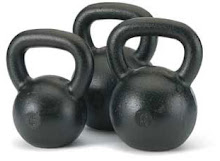
         Kettlebells, cast-iron weights that have been used for centuries to train Russian soldiers and athletes, appear to be a promising therapy for back and neck pain, new research shows.

         Although many people with backaches and other pains shy away from weight lifting for fear of hurting themselves, studies show that strength training can reduce pain and prevent reinjury. While most research has used traditional weight training exercises, researchers in Denmark set out to study whether a kettlebell workout offered therapeutic benefits to back pain sufferers.

          The weights, named for their resemblance to a tea kettle with a looped handle, began showing up in American gyms about 15 years ago and have gained a popular following among exercise buffs looking for a quick full-body workout. Unlike traditional weight training, which typically focuses on lifting exercises, a kettlebell workout requires both swinging and lifting of the weights, which for beginners can be awkward and difficult to control.

           In a study published last year, the Danish researchers recruited 40 pharmaceutical workers, mostly middle-aged women with back, shoulder and neck pain, who were randomly assigned to either a regular kettlebell workout or a control group that was simply encouraged to exercise. The first group trained with kettlebells in 20-minute sessions two to three times a week for eight weeks, according to the report, published in The Scandinavian Journal of Work, Environment & Health.
At the end of the study, the kettlebell exercisers reported less pain as well as improved strength in the trunk and core muscles, compared with the control group. Over all, working out with kettlebells reduced lower back pain by 57 percent and cut neck and shoulder pain by 46 percent.

         The study’s senior author, Lars L. Andersen, a government researcher in Denmark, noted that workers who spend much of the day sitting are particularly vulnerable to back, shoulder and neck pain because they develop tightness and weak spots along the posterior muscle chain, which includes the muscles running from the lower back down to the glutes, hamstrings and calves. Kettlebell workouts strengthen the posterior muscle chain, and the increased blood flow to the back and leg muscles also may lessen pain by reducing the buildup of lactic acid, the authors wrote.
While isolation exercises like curls and presses have their benefits, kettlebell movements recruit multiple muscles and teach the body “to move as one unit,” said J.J. Blea, a certified kettlebell instructor and an owner of Firebellz in Albuquerque, one of the top kettlebell gyms in the country.
Because kettlebells can be difficult to control, it’s important to learn proper form from a certified instructor or a kettlebell class at a gym. The cornerstone of the kettlebell workout requires the exerciser to swing the kettlebell between the legs. In the Danish study, women started with a 17.5-pound kettlebell and men with a 26.5-pound kettlebell.

     “When you’re doing a swing, you squeeze your quads, you squeeze your glutes, and you squeeze your abs,” said Mr. Blea. “By squeezing these muscles, you protect your back. It creates power, and it increases strength.”

        Kettlebell training is also surprisingly aerobic. A study by the American Council on Exercise found that a 20-minute kettlebell workout burns about 21 calories a minute, the equivalent of running at a six-minute-mile pace.

Here is the original post online: http://well.blogs.nytimes.com/2012/01/26/turning-to-kettlebells-to-ease-back-pain/?emc=eta1