In the midst of all this kettlebell talk, we sometimes forget to establish basic movement skills. Many of the most important movement patterns can start with bodyweight exercises. While most of you have done your share of pushups, crunches, and maybe even pullups, you may not have tried the inverted row. This exercise is used to balance out your pushups and bench presses, helping to increase upper back strength tremendously. Furthermore, your posture will improve significantly if this exercise is regularly performed. Give it a shot!
Friday, February 26, 2010


Monday, February 15, 2010
Ladies!...And Gentlemen...Don't Jump on the Bandwagon!
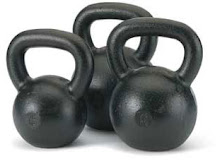
I am sure most of you have seen the kettlebells that are now being sold in Target, Walmart, Dick's Sporting Goods, etc. Many of them are extremely light, perhaps 5 or 7 pounds. A lot of times, they have moveable pieces or separate handles, perhaps wrapped in pretty, colored vinyl. Stay away from them! Don't buy them! Kettlebells are traditionally forged as a single piece of iron/ steel, starting at 8kg, which is 17.6 lbs. Unless you have a severe injury, which would prevent you from performing kettlebell training anyhow, you can safely use the 8kg kettlebell. I have not met a man or woman yet who fails to perform a proper kettlebell swing with 8kg, once they learn the proper technique!
Women are esspecially guilty of expressing anxiety when I suggest them to put down the 10 lbs kettlebell and pick up the 17.6 or 25 lbs kettlebell for swing. They often are conditioned by society to believe that heavier weight is not for them, or that they will be hospitalized upon attempting to pick one up. Ladies, how much does your squirming, hyper 2 year old toddler weight? How many times do you pick them up, load them in the car seat, or out of the bathtub? A inanimate 20 lbs kettlebell is no where near as hard to control as your son or daughter, and often just as heavy as your vacuum or bags of groceries.
Kettlebell training will get you stronger than you already are! Stop performing 50 reps with your 5 lbs weight, and instead, opt to challenge yourself with the 20-30 lbs bells. This truth applies to any traditional weight training you perform with barbells and dumbells too, so don't think it stops with just your kettlebell! Your will get wicked strong and lean, as well as shed the bodyfat. Even better, you'll be liberated from the social constraints of gender based strength training, which has been holding you back all these years with its lies!
Thursday, February 11, 2010
Altering Training Methods
Given that kettlebells are still relatively new for many people, traditional sets vs. reps training schemes are usually how most people training. For example, they may use a 16kg bell to perform snatches for 3 sets of 5 reps on each arm, with 1 minute of rest between each set. Most exercises are novel and exciting initially, so they feel little need to change how they utilize their respective exercises. However, as you learn to integrate more variety in your training, remember you can also chose different training schemes with the same exercises. Some basic options that come to mind are the following:
1) Circuit Training: Chose 3-5 exercises, for example, a 1 arm swing, 1 arm snatch, and 1 arm clean & press. Perform 10 reps of each exercise in a row, without rest. Repeat the circuit 1-2 more times.
2) Ladder Training: Performed with 2 or more people in a group. The larger the group, the more rest each person gets. Chose an exercise, like a 1 arm snatch. Each person does the same number of repetitions as the person before them, continuing in a sequence, until someone in the group fails to match the reps. For example, I do 5 reps, you do 5. I do 6, you do 6. I do 7, you do 7...continue until done.
3) 1 Minute Intervals: Chose a 1 arm exercise, like a 1 arm snatch. Perform 10 reps on each arm, as fast as you can. Whatever time is left in your minute, that is your rest period. Begin you second set on the "2 minute mark." Perform up to 5-10 minutes straight. You want an intense cardiovascular workout, give this a try!
Remember, keep learning, keep practicing...and above all, keep consistent. Along the way, have fun!
Friday, February 5, 2010
If you can dream it, doesn't mean you should do it!
Do a youtube video search for "kettlebell exercises," and you'll find many exercises that are ridiculously complicated. When you see them, don't just immediately attempt to perform them. First ask yourself, "Why?" Every exercise has a "cost versus benefit ratio." That means every exercise you perform has inherent risk for injury, some more than others. Likewise, each exercise has inherent benefits, which when performed correctly and consistently, outweigh its risks for injury. Before you perform any exercise, be CERTAIN that the potential reward greatly outweighs any risks. If you find yourself performing a pushup on a "bottom-up" kettlebell, while simultaneously having your feet wobbling on top of a stability ball, don't complain when you make your trip to the dentist!


Wednesday, February 3, 2010
MORNING WARM UP
One "secret" to prevent injuries and improve performance is the morning warm-up. It is simply 10 - 20 minutes of gentle mobility exercises done to lubricate the joints and get your body ready for the day. There is no gospel as to the order of the exercises, just be slow in your speed of movement and gradually increase your range of motion rep after rep. Steve Maxwell says the number of reps for each exercise movement should be equal to your age. Have you ever watched Steve? I would listen to him!
Wednesday, December 23, 2009
Another short and sweet kettlebell routine!
I posted a 5 minute kettlebell routine focusing on total body recruitment, which quickly became very popular on youtube. So in response to that demand, I turned the video camera on during one of my many shoulder exercise circuits. Here it is:
Please keep in mind that these are advanced exercises. If you have not mastered the basic swings and getups, and perhaps even cleans, presses, and snatches (videos to come), I would focus on those exercises first. For the record on terminology, the video above shows exercises in the following order:
1) Kettlebell Pummel
2) Kettlebell Side Press
3) Kettlebell Bend Press (with some Kettlebell Windmills thrown in as well)
Double Kettlebell Swing
I posted an earlier video for the basic 1 arm kettlebell hip swing. As you all know, the 2 arm and 1 arm hip swings are considered the foundation of kettlebell training. Everyone should master both versions, as well as the kettlebell turkish getup, before attempting to incorporate other exercises and their variations.
However, for those who have mastered the basics, and who do not have very heavy kettlebells, here is a variation of the kettlebell swing you may wish to try.
The beauty of the double kettlebell swing is that it allows you to overload the hip and core musculature, even if you don't own heavier kettlebells. At the office, the heaviest kettlebell we have is 40kg or 88lbs. I would like to train with twice that weight, so the closest I can get right now is using (2) 32kg kettlebells, which translates into a total of 64 kg or 140.6 lbs.
The challenge is that as your kettlebell size increases, you must create a wider stance for them to pass under you hips. You must also be certain to rotate your wrist inward as you pass under your hips to make certain you do not hit the heavy kettlebell into your thigh. Believe me, that is a BAD idea! ROTATE THOSE WRISTS!
Double Kettlebell Cossack
I posted an earlier video showcasing the "bottom up kettlebell cossack", which is a great exercise for lower body strength and flexibility. For those who wish to throw in more challenges for your upper body and core, try the double kettlebell cossack. Each hand holds a kettlebell in the "rack position", creating a lot of tension around the shoulders, lats, and obliques. I consider this a more advanced exercise, so if you haven't mastered the basics, let this be a goal for yourself!
Monday, December 21, 2009
Why can't you swing your kettlebell right? (Part 3)
We have touched on gluteal amnesia and poor core strength as two culprits in hurting your kettlebell swing. The third thing that is very often a problem is slow hip drive. The kettlebell swing is not supposed to be a "slow-controlled" movement. To reverse the kettlebell arc between your legs, there should be a fast, powerful, and VISIBLE hip drive. Your hip should "POP!" forward, faster than you can say the word out loud! Start popping!
Rehab your Shoulders By "Getting-Up"
Many people know the turkish getup is a great exercise for your core and leg flexibility and strength. However, some in my field would argue that it is even better for shoulder rehabilitation, especially if you are doing a few in a row. Because of the long "time under tension" around the shoulder capsule, both the stabilizing rotator cuff muscles and the strong deltoid muscles of the shoulder are recruited effectively. Check out the exercise here:
In fact, the benefits of greater shoulder stability and strength are greatly improved if you decide to only do "partial getups" instead. For added shoulder instability, try holding the kettlebell "bottom-up", for an even more difficult task on the shoulder musculature.
In fact, the benefits of greater shoulder stability and strength are greatly improved if you decide to only do "partial getups" instead. For added shoulder instability, try holding the kettlebell "bottom-up", for an even more difficult task on the shoulder musculature.
Subscribe to:
Posts (Atom)